In the grand narrative of tech investing, Wall Street’s greatest skill is packaging every small technological iteration into a total addressable market (TAM) worth hundreds of billions of dollars. In this round of AI compute euphoria, “optical interconnect” is undoubtedly one of the concepts lit most brightly by the spotlight — from “the compute explosion must make optical modules ubiquitous” to “CPO technology reshapes the data center,” aggressive research reports keep stimulating investors’ nerves.
Yet when you peel away these carefully wrapped illusions and return to the most basic server bill of materials (BOM) and physical engineering reality, a deliberately ignored truth emerges: the optical interconnect concept is facing serious overhype. In the power map of AI hardware, it is just a marginal player with no pricing power.
1. The Truth in the Ledger
The absolute core of AI hardware is only the GPU and HBM.
Wall Street loves to show you the year-over-year doubling of optical interconnect device shipments, but it rarely lets you look at the real cost breakdown of a standard AI server.
Take the 8-GPU NVIDIA H200 server that is now standard in data centers worldwide. Its full-system manufacturer suggested retail price (MSRP) is about $350,000. When you break down that bill, the real monopoly structure of the value chain is clear at a glance:
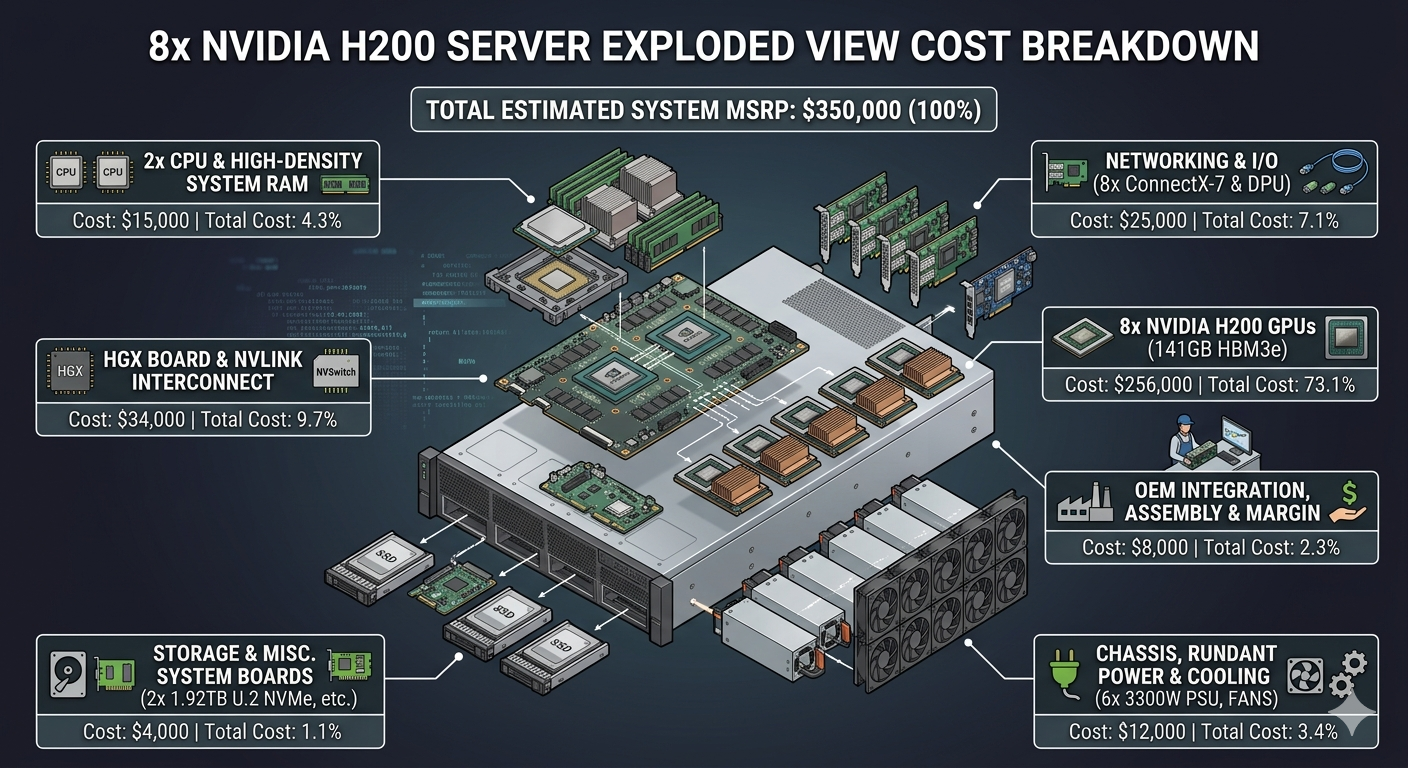
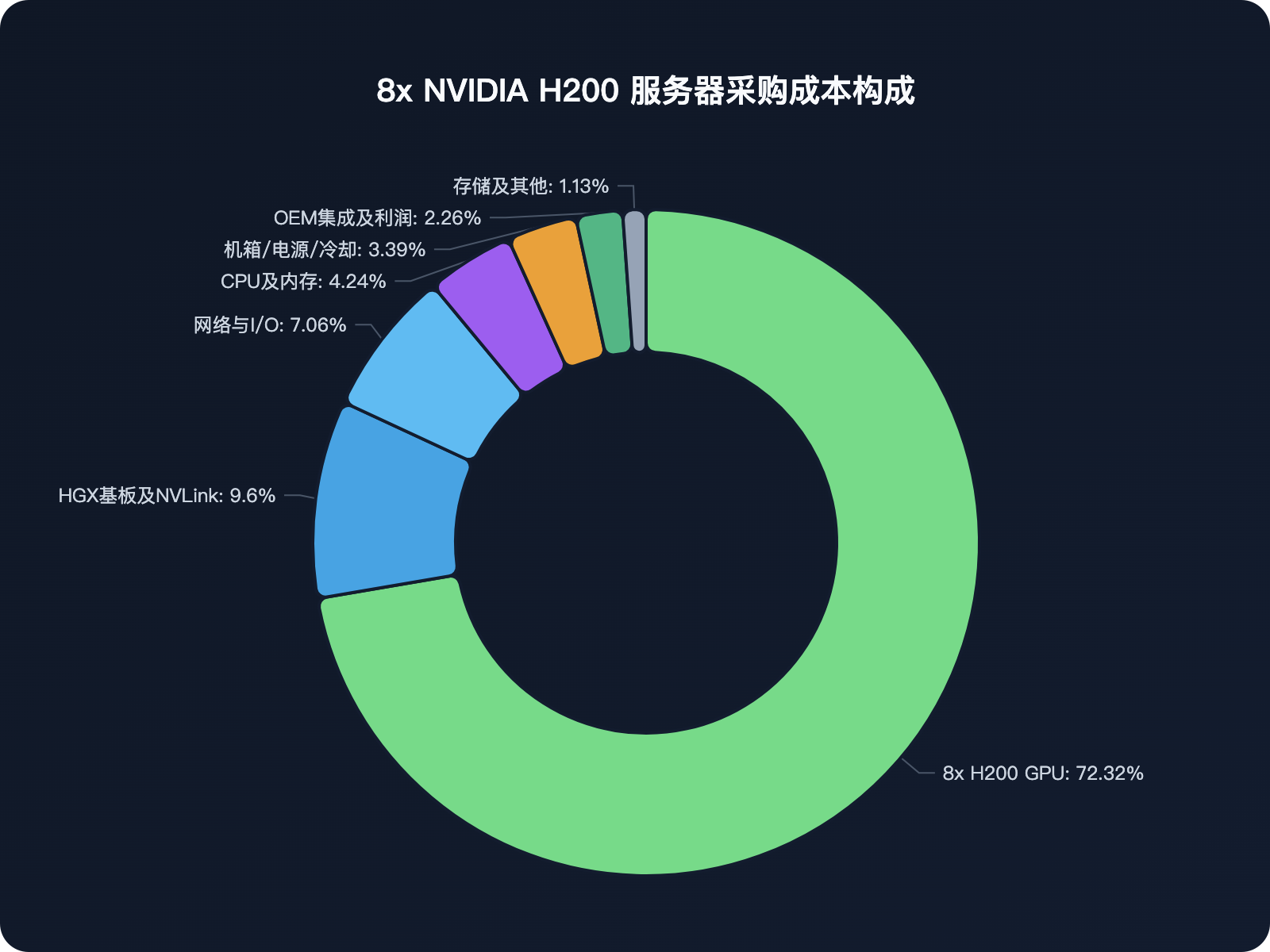
- Absolute core: 8 H200 GPUs configured with 141GB of HBM3e memory cost as much as $256,000 to procure, directly swallowing 70% of the money for the whole machine.
- Marginal share: the entire networking and I/O component, including high-speed network cards and optical communication interfaces, accounts for only 7% of the procurement cost of a single machine.
In AI hardware, any component that does not directly contribute compute (FLOPS) or memory bandwidth (HBM) is peripheral equipment. NVIDIA, with its core chips and CUDA ecosystem, takes nearly half of the entire industry chain’s net profit, while optical interconnect devices are extremely marginal hardware in the whole machine. With no ecosystem moat, their value simply has no basis for an explosion.
2. In-Rack Interconnect: The Overrated “All-Optical” Imperative
Wall Street’s narrative logic is linear extrapolation: faster speeds must mean more optics. But what they don’t tell you is that copper interconnect has made huge breakthroughs over short distances:
Today’s pure-copper NVLink 6 already delivers 3.6TB/s full-duplex per GPU and a rack-level one to two hundred TB/s of astonishing bandwidth — at least for now, quite sufficient.
Optical communication sounds fast, but it must undergo 2 optical-electrical conversions during transmission, a process that introduces unavoidable physical latency, and optical-electrical conversion also has energy consumption and heating problems. Copper interconnect is a mature process, technically stable, transmits electrical signals directly, with near-zero latency and an extremely high price-performance ratio.
For downstream customers (such as cloud service providers), the existing copper interconnect solutions inside the rack are already fast enough and stable enough. This is just like the 5G concept and the IPv6 upgrade back then — the technical specs were perfect, but with the old 4G and IPv4 still sufficient and extremely cheap, users lacked any urgent motivation to upgrade.
3. Cluster-Scale Optical Interconnect: No Breakout Logic
Of course, the value of optical interconnect cannot be denied. In building ultra-large clusters, optical interconnect has advantages copper cables cannot replace:
- Breaking distance limits: when ten-thousand- or hundred-thousand-GPU clusters need to connect across racks, across server rooms, or even across buildings, copper cables suffer severe physical signal attenuation beyond 2–3 meters. At that point, fiber communication is required to break through the distance limit.
- But this will not create a value explosion: optical interconnect does have rigid scenarios in multi-rack clusters, but it cannot change its marginal position of only single-digit percentages in overall data center capital expenditure (CapEx). More importantly, this kind of optical communication equipment lacks the kind of technology patent monopoly and software ecosystem lock-in that core compute chips have. As foundries scale up production and yields improve, its ASP (average selling price) will inevitably be continuously pressed down by downstream customers.
Conclusion
Wall Street manufactures the growth myth of “optical interconnect,” overhyping the optical interconnect concept. We must see the hard logic underneath: the absolute center of gravity in AI hardware is always the core chips (GPUs) and high-bandwidth memory (HBM). Optical interconnect will certainly have a place in AI hardware — but only a place. It will not become the next NVIDIA.